Buying Commercial Property in Istanbul: Shops & Offices 2026
Buying commercial property in Istanbul as a foreigner: ownership rules, why shops don't give residency, citizenship, taxes, rents and a buying checklist.
Buying commercial property in Istanbul is open to foreigners within the framework of the law, and ownership works much like buying a home. Residency, tax and rental rules are different, though. The key point: a shop or office does not count for a property-based residence permit, but it can be considered for the USD 400,000 citizenship route, provided you get confirmation for that exact property before you pay.
This guide is based on official sources and market reports up to 2 November 2026 and applies to shops, offices and the commercial units of mixed-use buildings.
What commercial property can foreigners buy in Istanbul?
A foreign individual can buy shops, offices, warehouses and commercial units, subject to the Land Registry Law (Tapu Kanunu) and to military and security zones. Article 35 of that law sets two caps: a foreigner's total holdings across Turkey may not exceed 30 hectares, and in any one district may not exceed 10% of the district's privately owned land. For a shop or office in Istanbul these caps are rarely a problem, but the land registry (Tapu Müdürlüğü) must check the military-zone status before you buy.
If you plan to buy through a company the rules change: a company established in Turkey with foreign capital may acquire property under conditions, and in some cases needs permission from the governorate (Valilik). A company registered abroad may acquire property only in exceptional cases under special laws. Take legal advice before choosing a structure.
Buying remotely is also possible; see Buying property in Turkey with a power of attorney.
Commercial property and residence permits: why shops and offices don't count
Most sellers' articles skip this. According to the document list on the e-İkamet portal of Turkey's migration authority, a property-based residence permit requires the title deed to be in the foreigner's name, a value of at least USD 200,000 (in lira) on the acquisition date, a property that is a residence (mesken), and no use for rental income. A shop or office does not meet the residential requirement, and a property you intend to let out does not fit the purpose of this permit either.
So if residency is your main goal, choose a residential apartment and treat a shop as a separate investment. For family permits, read Family residence in Turkey through property.
Commercial property and the USD 400,000 citizenship route
The citizenship-by-investment route needs real estate worth at least USD 400,000 (or the equivalent in foreign currency) and a no-sale note on the title deed for at least three years. Several properties can be combined to reach the threshold if they are all in one applicant's name. According to legal and property sources, Turkey's Investment Office has stated that eligible foreigners may acquire a broad range of real estate, including commercial property, and the official wording does not mention a residential requirement for citizenship. That is a reading of the text, not a guarantee; before you move the main payment, check the valuation report, bank payment and eligibility certificate for the specific property.
Practical points:
- An SPK valuation report is needed to prove the value: Official property valuation report.
- A three-year no-sale period makes liquidity important; a shop with few buyers can become expensive to hold.
- A budget of USD 400,000–500,000 usually does not buy a prime shop in Istanbul; one agency's analysis says that at this budget you can typically only get a shop or office in a secondary location.
- Full details of the citizenship route: Turkish passport by property investment.
The Istanbul commercial property market in 2026: prices and rents
For prices, we used the Central Bank of Turkey (TCMB) instead of sales-brochure figures. Its commercial property price index for the second quarter of 2026 (base 2023 = 100) shows:
| Index | Annual change (nominal) | Annual change (real, after inflation) |
|---|---|---|
| All commercial property | +29.4% | −2.2% |
| Shops | +29.2% | −2.4% |
| Offices | +30.6% | −1.3% |
| Istanbul (overall) | +27.8% | Not published |
Source: TCMB, Q2 2026, as reported by the press on 17 August 2026.
In plain terms: prices rose about 28–30% in lira, but inflation was higher, so real shop and office prices fell by one to two percent. These are national and Istanbul-wide figures and do not tell you the value of a specific building.
On rents, Cushman & Wakefield's report for the first half of 2026 gives these prime rents:
| Area | Monthly rent (USD per m²) |
|---|---|
| Office, Levent-Etiler | 52 |
| Office, Maslak | 40 |
| Office, Esentepe-Gayrettepe-Zincirlikuyu | 35 |
| Main-street retail, Istanbul | 250 (unchanged from last year) |
Source: Cushman & Wakefield, H1 2026, via Para Dergi, 17 August 2026. These are rents for the best buildings and streets, not the market average; a shop in an ordinary neighbourhood lets for far less.
On sales, TÜİK's bulletin (as reported by the media) shows 17,345 workplaces (iş yeri) sold across Turkey in September 2026, 3.8% fewer than a year earlier; new-build sales were 5,789 (+13.2%) and second-hand 11,556 (−10.5%). The next bulletin (October) is due on 17 November 2026. For foreign housing sales see the monthly statistics page and the September report.
Which Istanbul areas matter for commercial property?
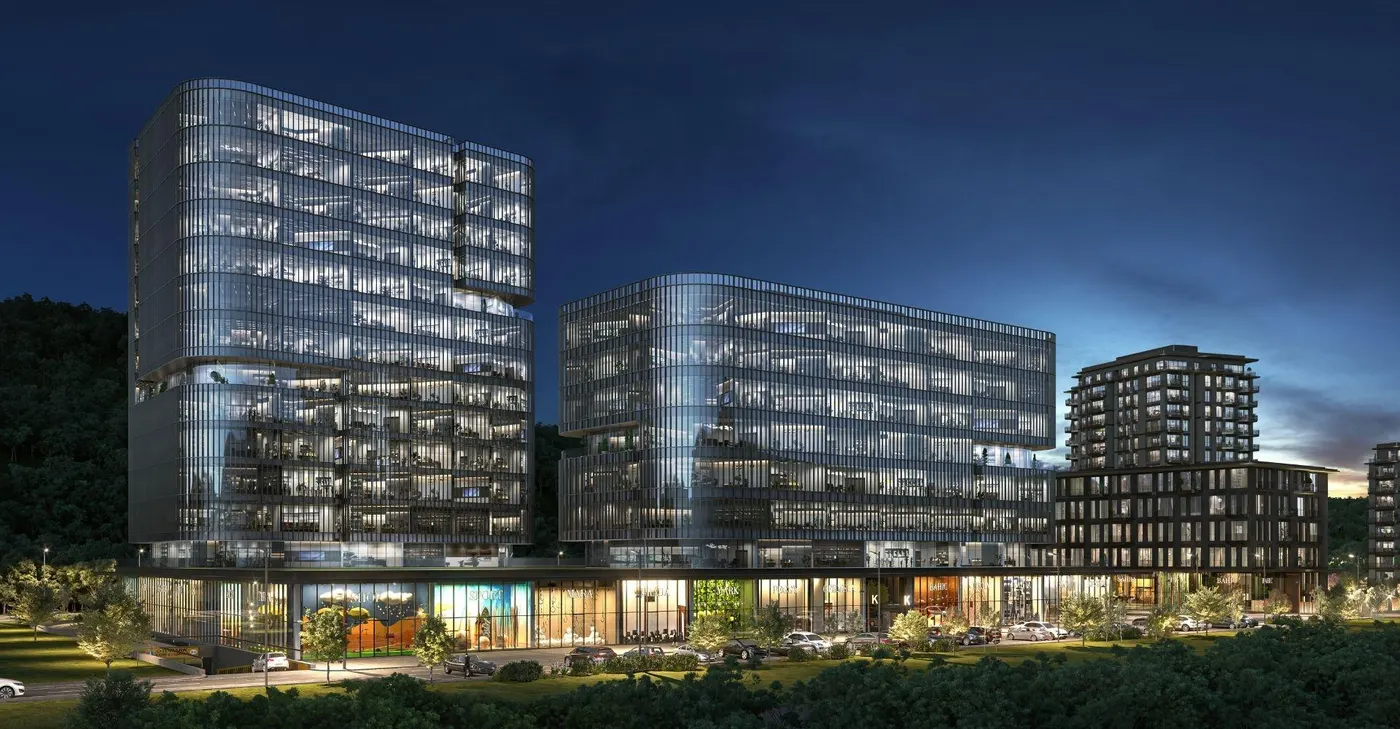
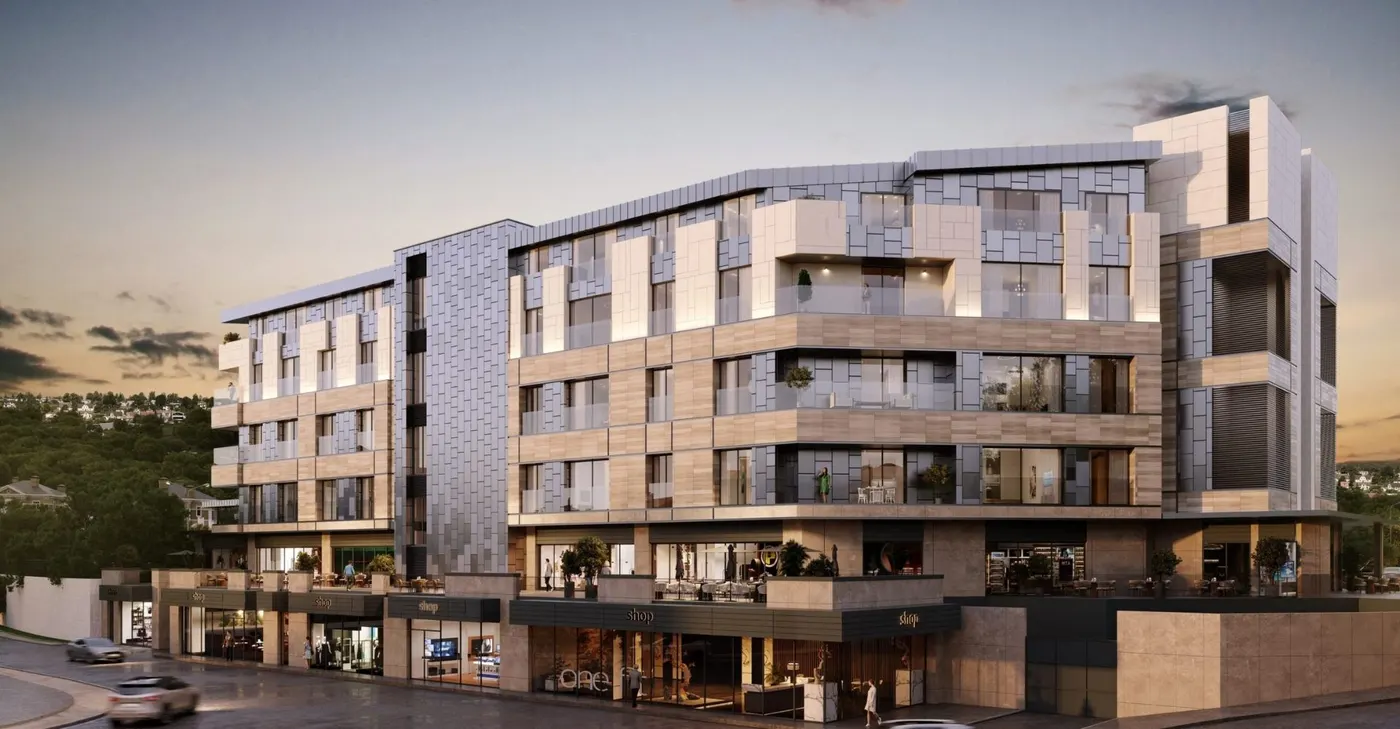
Prime office space is concentrated along the Levent and Maslak axis, which is what the rent report shows. Busy shops are usually on main streets and on the ground floors of mixed-use projects. In Kağıthane and Göktürk new mixed-use projects are being built. Guide to the districts: Istanbul districts.
ALO TURKEY has projects on these axes: Maslak Koru and RAMS Park House in Maslak, Pelit Levent in Levent and Seba Center Residences in İstinye. Most are residential and some have commercial ground floors; ask our consultants whether a commercial unit is available and on what terms. Unit prices are not published and are given only in conversation with a consultant.
Costs and taxes when buying commercial property
One-off costs are like those for a home: title-deed tax of 4% (2% buyer and 2% seller, by agreement), land registry service fees, the extra fee for foreigners per property (TRY 20,868 in the 2026 TKGM tariff), an agent's commission of at most 2% plus VAT, and DASK insurance. Use the Property buying costs calculator for your own price and read Property tax and hidden costs for the full list.
Two points specific to commercial property:
- VAT exemption for non-resident foreigners. Under VAT Law article 13/i, a non-resident foreigner can be exempt from VAT when buying a home or workplace (işyeri) from a developer, but only on the first delivery by the developer, with at least 50% of the price paid in foreign currency brought into Turkey before the invoice date and the rest within a year, and with a three-year no-sale undertaking recorded on the title deed. If the conditions are not met or the property is sold early, VAT and penalties fall on the parties. Check this with a tax adviser before signing.
- Annual property tax (Emlak Vergisi). In metropolitan cities the 2026 rate is 0.2% of the tax value for residential property and 0.4% for other buildings, including shops and offices, which is double the rate for a home.
Tax and contract on renting out a shop or office
Commercial rental income does not get the residential rent exemption (TRY 58,000 in 2026). If the tenant is a company or business it normally withholds 20% of the rent (stopaj) and pays it to the tax office, and you account for it in the annual return (1–31 March). Details and tax brackets are in Rental income tax in Turkey 2026.
In the lease, know this:
- Under article 344 of the Code of Obligations (TBK) the cap on rent increases is the 12-month average of consumer inflation (TÜFE).
- A landlord usually cannot remove a tenant just because the term has ended; termination without a reason is only possible after the ten-year extension period with three months' notice, and how those ten years are counted is disputed between courts. A weak tenant can therefore occupy a unit for years.
- Since 1 September 2023, mediation (arabuluculuk) is a precondition to going to court in rent disputes.
Risks to check before you buy
- Property type on the deed. A unit registered as residential in the tapu but used as a shop or office is a problem: under article 24 of the Condominium Law (Kat Mülkiyeti Kanunu) converting a residential unit to a workplace needs a unanimous vote of all owners, and a separate municipal permit. The deed should say iş yeri or dükkan.
- Business permits. The tenant's activity (café, clinic, office) must match the building's permit and rules; some activities, such as clinics, cannot be opened in a unit registered as residential.
- Vacancy risk. Commercial property has less stable tenants than a home. Compare the yield claimed in marketing with the actual rent in that building. Some sellers' analyses quote unsourced figures; we did not use any.
- Earthquake and building condition. Check the year of construction and technical reports: Earthquake-safe buildings in Istanbul.
- High cost of entering and leaving. With transfer taxes and fees, a quick resale rarely makes a profit.
Checklist for buying a shop or office in Istanbul
- Define the goal: residency (residential only), citizenship (USD 400,000) or rental income.
- Before paying, get confirmation from an adviser or lawyer for that exact property and goal.
- Check the title deed (tapu): property type, mortgages, seizures, zoning status and occupancy permit.
- Review the existing lease, its term, rent and the tenant.
- Get an SPK valuation report and compare the price with similar units.
- Work out the VAT exemption conditions and the annual tax.
- Prepare DASK insurance and a budget for transfer costs.
- Complete the deal only at the land registry (Tapu Müdürlüğü) with a sworn translator.
FAQ
Can foreigners buy a shop or office in Istanbul?
Yes, within the Land Registry Law and outside military and security zones; the title is transferred at the land registry with a sworn translator.
Do I get a Turkish residence permit by buying a shop?
No. A property-based permit needs a residential property worth at least USD 200,000, and shops and offices do not qualify.
Is commercial property accepted for the USD 400,000 citizenship route?
According to reports of the Investment Office's position, commercial property can be considered, but it is not guaranteed and you must get confirmation for each property before paying. You may not sell for three years.
How much tax is due on shop rent?
A company tenant normally withholds 20% of the rent, and the residential rent exemption does not apply to shops. Have the final calculation done by a certified accountant.
What is the price per m² of a shop or office in Istanbul?
No official per-m² price for shops is published; we used only the central bank index and prime rents from credible reports. Test the real price against the valuation report for the property.
Is a shop or an apartment better?
It depends on your goal. An apartment offers better liquidity and residency; a shop can earn higher rent but carries vacancy risk and higher annual tax.
Free consultation with ALO TURKEY
Rules and taxes change. Before any commercial purchase, talk to ALO TURKEY's consultants through WhatsApp or the contact page.
Sources: Central Bank of Turkey (TCMB) commercial property price index, Q2 2026; Cushman & Wakefield H1 2026 (via Para Dergi); TÜİK housing and workplace sales bulletin, September 2026; e-İkamet portal of the Turkish migration authority; Citizenship Law implementing regulation (5627) and Investment Office statements as reported; Land Registry Law (2644); VAT Law article 13/i (3065); Condominium Law (634); Code of Obligations (6098); Property Tax Law (1319), 2026 rates. Data as of November 2026.